Air Purifiers · Comparison
Boon Airvana vs Xiaomi Air Purifier 4: Which to Buy?
Which should you buy?
Buy the Boon Airvana for the fastest clean-up, quieter running and eight-parameter air-quality sensing. Buy the Xiaomi Smart Air Purifier 4 if you use Xiaomi Home, want lower power draw, or prefer buying from Amazon or Croma over a brand store.
Choose the Boon Airvana Smart Air Purifier if
- You want the fastest clean-up we measured: 16 minutes in our test bedroom
- You want to see PM1, PM2.5, PM10, TVOC, NO2 and estimated CO2, not just particles
- You want a quieter purifier, both on Sleep and at top speed
- Your home runs on Alexa, Google Home or Matter
Choose the Xiaomi Smart Air Purifier 4 (AC-M16-SC) if
- You already use the Xiaomi Home app and ecosystem
- You want lower power draw at top speed, about 36 W against 48 W
- You prefer buying from Amazon or Croma rather than the brand's own store
- You want a stated filter life, which Xiaomi puts at about 12 months
We may earn a commission when you buy through links on this page. It never affects our verdict, and we never accept paid reviews. How we make money
Boon Airvana Smart Air Purifier vs Xiaomi Smart Air Purifier 4 (AC-M16-SC): side by side
| Boon Airvana Smart Air Purifier | Xiaomi Smart Air Purifier 4 (AC-M16-SC) | |
|---|---|---|
| Overall | ||
| Our grade | A 9.1 (better result) | B 7.7 |
| Test results | ||
| PM2.5 clean-up, 180 sq ft bedroom How we test this : PM2.5 clean-up, 180 sq ft bedroom | 16 min (better result) | 18 min |
| Noise on lowest or Sleep setting How we test this : Noise on lowest or Sleep setting | 29 dB (better result) | 34 dB |
| Noise at top speed How we test this : Noise at top speed | 57 dB (better result) | 62 dB |
| Power draw at top speed How we test this : Power draw at top speed | 48 W | 36 W (better result) |
| PM2.5 reading vs reference monitor How we test this : PM2.5 reading vs reference monitor | Within about 10-15% | 12 % |
| Key specs | ||
| Price at review | MRP ₹19,900 | Typical price ₹18,999 |
| CADR | 380 m3/h | — |
| Room coverage (Boon claim) | About 484 sq ft at a 3 m ceiling | — |
| Filtration | Washable pre-filter, H13 HEPA, activated carbon, anti-bacterial coating | Pre-filter, high-efficiency filter, activated carbon |
| Filters | Dual filter, air drawn in from both sides | — |
| Sensor | 8 parameters: PM1.0, PM2.5, PM10, TVOC, NO2, eCO2, temperature, humidity | — |
| Modes | Auto, Sleep, Eco; 4 fan speeds | — |
| Display | Full-colour round display | OLED touch |
| Smart features | Boon app, Alexa, Google Home, Matter | Xiaomi Home app, Google Assistant, Alexa |
| Warranty | 1 year, send-in service | — |
| Particle CADR | — | 400 m3/h |
| Formaldehyde CADR | — | 150 m3/h (Xiaomi global page) |
| Effective coverage (Xiaomi) | — | 28-48 m2 (global page) |
| Sensors | — | Laser particle, temperature, humidity |
| Noise (Xiaomi) | — | Up to 64 dB(A) |
| Filter replacement | — | About 12 months, usage dependent (Xiaomi) |
Which cleans a smoggy bedroom faster?
The Boon Airvana, by a small margin. In the same closed 180 sq ft bedroom, during the same stubble-burning weeks, it brought PM2.5 under 35 ug/m3 two minutes sooner than the Xiaomi. Both are fast enough for a typical Delhi bedroom in November; the difference only starts to matter in bigger rooms. Xiaomi lists a higher particle CADR than Boon does, but the Airvana draws air in through two HEPA filters, and in our room it was the quicker of the two.
Which is quieter at night?
The Boon Airvana. Its Sleep setting was close to a quiet room, and even at top speed it was noticeably quieter than the Xiaomi, whose turbo is loud enough to talk over. Both have an Auto mode that follows the air quality and drops the fan once the room is clean, so the gap matters most when you cook, open a door or start a clean-up before bed.
Which tells you more about your air?
The Boon Airvana reads eight parameters, including TVOC and NO2, which helps in a road-facing flat or near the kitchen; its CO2 figure is an estimate, not a true sensor reading. The Xiaomi reads particles, temperature and humidity, and has no gas sensor, so cooking fumes and fresh paint do not register. Both PM2.5 readings stayed close to our reference monitor, and both apps handle schedules well.
Which is easier to live with over the years?
This is closer. The Xiaomi draws less power at top speed, is sold through large retailers and has a filter life stated by the brand, though neither brand published an Indian replacement filter price that we could find. The Boon Airvana is new, with no long-term owner history, and its warranty is one year and send-in. Xiaomi’s service network is also thin outside the metros, so in a tier-2 city check where the nearest service point is before you buy either.
Questions buyers ask
Which is faster, the Boon Airvana or the Xiaomi Smart Air Purifier 4?
The Boon Airvana was faster in our tests. In a closed 180 sq ft bedroom it brought PM2.5 from about 300 to under 35 ug/m3 in 16 minutes; the Xiaomi Smart Air Purifier 4 took 18 minutes.
Is the Boon Airvana quieter than the Xiaomi Smart Air Purifier 4?
Yes. At 1 metre the Boon Airvana measured about 29 dB on Sleep and 57 dB at top speed, against about 34 dB and 62 dB for the Xiaomi Smart Air Purifier 4.
Do the Boon Airvana and Xiaomi Smart Air Purifier 4 work with Alexa and Google?
Both do. Boon lists Alexa, Google Home and Matter support for the Airvana. Xiaomi lists Alexa and Google Assistant for the Smart Air Purifier 4 through the Xiaomi Home app.
Which has better after-sales service, Boon or Xiaomi?
Neither is strong outside the metros. The Boon Airvana has a one-year, send-in warranty with no on-site visits. Xiaomi's service network for the Smart Air Purifier 4 is thinner than Philips or Dyson, and spare filters are sold online with waiting times that vary by city.
Read the full reviews
-
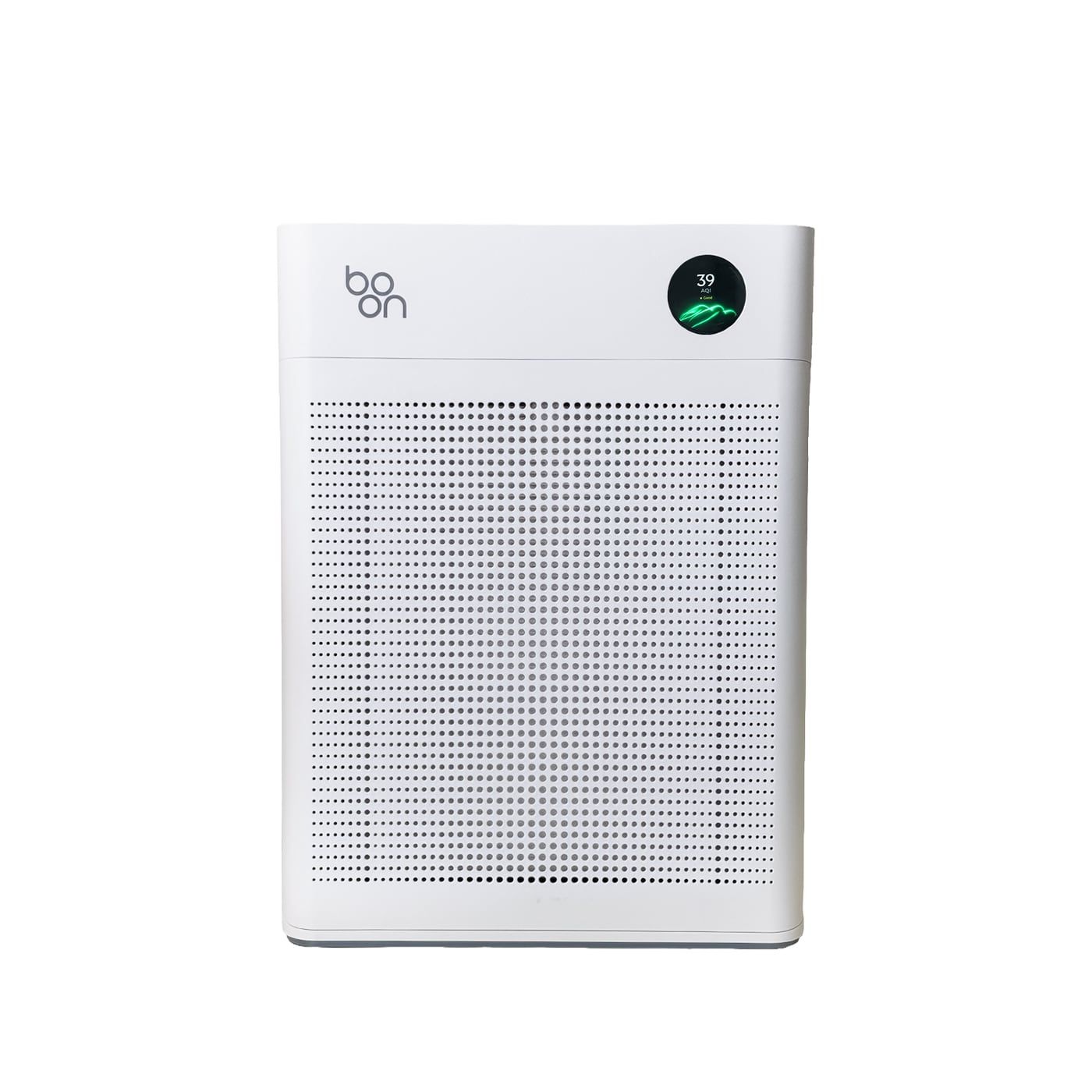
Air Purifiers
Boon Airvana Review: Dual HEPA, 8-Sensor Purifier
The Boon Airvana is the best home air purifier we tested for Indian winters: 380 m3/h CADR, two H13 HEPA filters, eight-parameter sensing and full app and smart-home control.
Editor’s Choice -
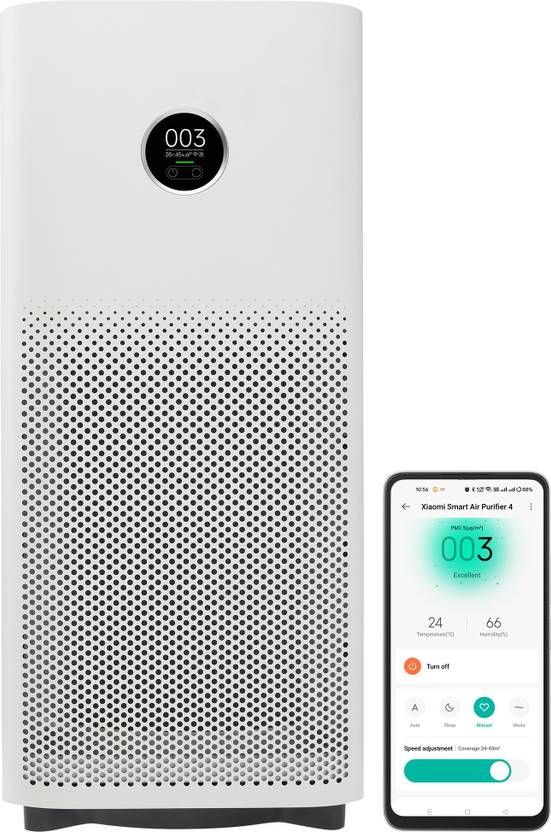
Air Purifiers
Xiaomi Smart Air Purifier 4 (AC-M16-SC) Review: Strong Value
The Xiaomi Smart Air Purifier 4 (AC-M16-SC) cleans a bedroom nearly as fast as the best purifier here, with a good app and sensor, at a much lower price than Dyson.
Best Value